Minimum Drop Percent Filter
The minimum drop percentage filter (also called Delta % or Δ %) determines how large an odds drop must be before you receive an alert. Learn how to configure this filter effectively to balance alert quality and quantity.
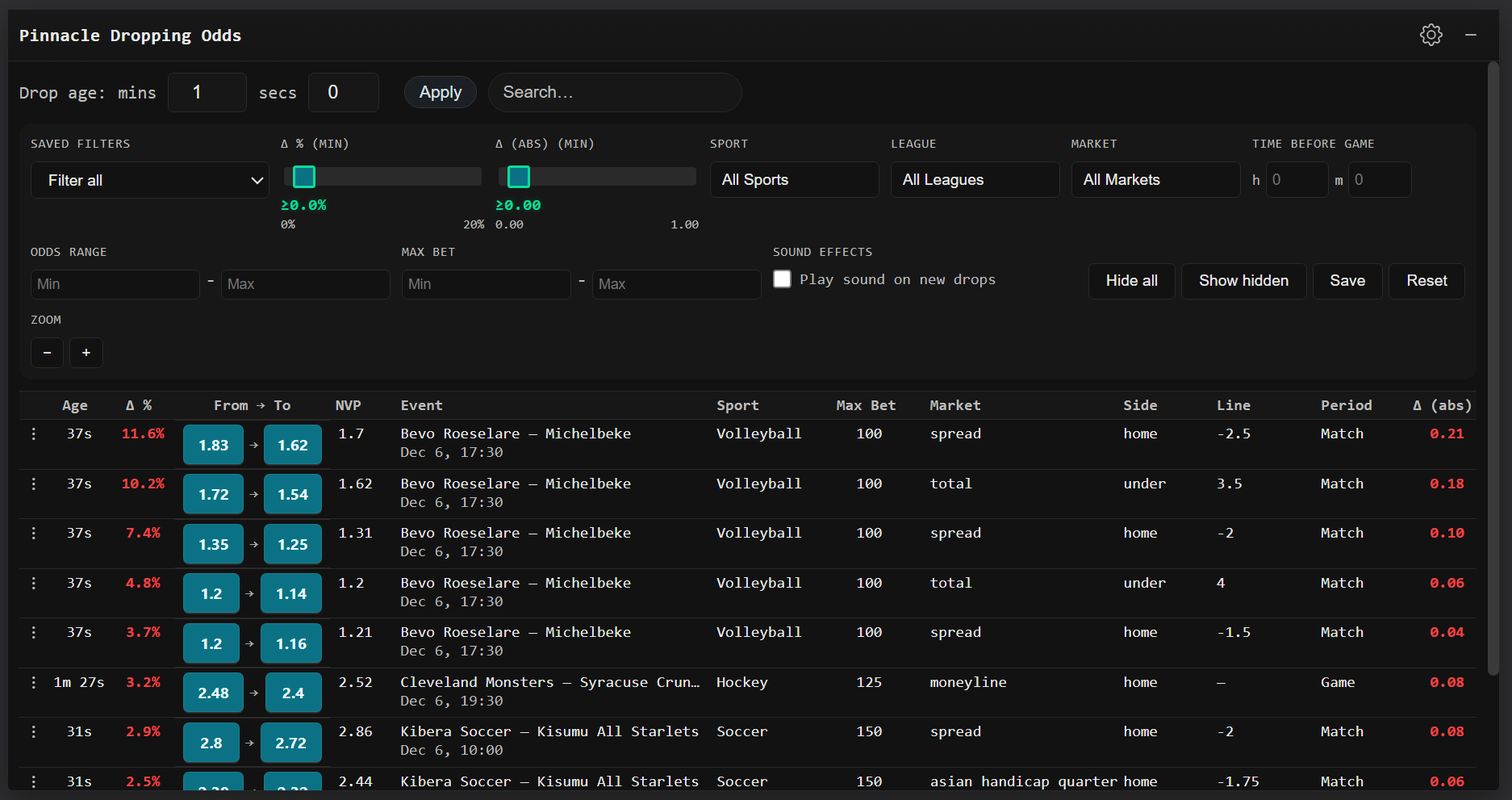
The minimum drop percent filter is one of the most important filters in your dropping odds configuration. It acts as a quality gate, ensuring you only receive alerts for significant market movements.
This filter helps you focus on the most valuable opportunities while filtering out smaller, less significant drops that may not offer enough expected value to justify placing a bet.
Understanding how to set this filter correctly can significantly impact your alert-to-bet conversion rate and overall profitability.
For more information on configuring all your alert filters, see our tailoring alert configurations guide.
How Does the Minimum Drop Percent Filter Work?
The minimum drop percentage filter allows you to set a minimum drop size for your dropping odds alerts.
For example, if you set it to 10% and there is a drop of 9%, you won't receive the alert. But if there is a drop of 11%, you will receive the alert.
The filter uses a slider that ranges from 0% to 20%, allowing you to set your minimum threshold precisely.
The odds used in the drop percentage calculation are the normal odds before the vig has been subtracted. This means you're seeing the actual percentage change in the market price.
The drop percentage is calculated by comparing the original odds to the new odds after the drop. For example, if odds move from 2.00 to 1.80, that represents a 10% drop ((2.00 - 1.80) / 2.00 × 100 = 10%).
This filter works in conjunction with other filters like the delta absolute filter, which measures the absolute decimal change in odds rather than the percentage change.
For more information on understanding market movements, see our Pinnacle dropping odds manual.
Recommended Minimum Drop Percent
Users have had success with minimum drop percentages of anywhere from 5% to 15%.
We would not recommend going below 5% though, as you aren't going to be finding enough expected value to bet confidently on less efficient markets owing to the fact you are chasing smaller drops.
Smaller drops (below 5%) often don't provide enough margin of safety, especially when accounting for the vig and potential pricing inefficiencies between the sharp bookmaker and your soft bookmakers.
For most bettors, starting with a minimum drop percent of 7-10% provides a good balance between alert quality and quantity.
However, the optimal setting depends on several factors:
- Your experience level with dropping odds betting
- The markets you're focusing on (more efficient markets may require lower thresholds)
- Your bookmaker coverage and how quickly they adjust
- Your risk tolerance and bankroll size
Experienced bettors who understand market efficiency and have quick access to multiple bookmakers may be able to work with lower percentages (5-7%), while beginners should start higher (10-12%) to ensure they're only seeing the most valuable opportunities.
How the Minimum Drop Percent Affects Your Turnover
The minimum drop percentage acts as a filter for your alerts. A higher percentage means fewer, but potentially more valuable alerts.
Conversely, a lower percentage increases alert frequency but may include less significant opportunities.
This creates a trade-off between alert quality and quantity that directly impacts your betting turnover.
Finding Your Sweet Spot
Experiment with different minimum drop percentages to strike the perfect balance between alert quality and quantity.
This 'sweet spot' varies for each bettor, depending on their strategy and goals. Some bettors prefer fewer, higher-quality alerts, while others want more opportunities to choose from.
Monitor your alert-to-bet conversion rate over time. If you're receiving many alerts but placing few bets, consider raising your minimum drop percent. If you're receiving too few alerts, consider lowering it slightly.
Keep in mind that your optimal setting may change as you gain experience and as market conditions evolve.
Boosting Turnover
If you're looking to increase your betting turnover, consider lowering your minimum drop percentage. However, approach this adjustment cautiously.
Remember these important principles:
- Quality over quantity: More bets don't always mean more profit. Placing bets with insufficient expected value will hurt your long-term profitability.
- Preserve positive EV: Never compromise on positive expected value for the sake of higher turnover. Every bet should have a clear positive expected value.
- Gradual adjustments: Make small, incremental changes and monitor results. Don't jump from 10% to 3% overnight—adjust gradually and track how it affects your results.
Lowering your minimum drop percent can increase turnover, but only if you maintain discipline and only place bets when there's genuine value. More alerts don't automatically mean more profitable bets.
For more information on optimizing turnover while maintaining profitability, see our betting turnover optimization guide.
Bigger Drop Percent for Less Efficient Markets?
For low-limit, high-vig markets, bettors should set a higher minimum drop percent to ensure a larger margin of safety.
This compensates for potential inefficiencies in the sharp bookmaker's pricing. When markets are less efficient, there's more uncertainty in the pricing, so you need a larger drop to ensure there's genuine value.
To find bigger discrepancies between the sharp bookmaker and soft bookmakers in these markets, one needs to catch larger drops.
Therefore, when betting on inefficient markets, a bettor should consider a relatively high minimum drop percent. A starting point of 10% is recommended for such scenarios.
Inefficient markets are typically characterized by:
- Low betting limits at the sharp bookmaker
- High vig (overround) in the market
- Less liquid markets with fewer participants
- Markets far from match start with more uncertainty
In these situations, a larger drop percentage helps ensure that even after accounting for pricing inefficiencies and the vig, there's still sufficient expected value to justify placing the bet.
For more efficient markets (high limits, low vig, close to match start), you may be able to work with lower drop percentages (5-7%) because the pricing is more accurate and there's less uncertainty.
For more information on understanding market efficiency, see our Pinnacle dropping odds manual.
Ready to configure your minimum drop percent filter? Use FairOdds Terminal to set up custom alert filters and optimize your dropping odds strategy with the right balance of quality and quantity. For the complete strategy behind these settings, read the dropping odds strategy guide.
Minimum Drop Percent Filter FAQ
How does the minimum drop percent filter work?
The minimum drop percentage filter allows you to set a minimum drop size for your dropping odds alerts. For example, if you set it to 10% and there is a drop of 9%, you won't receive the alert, but if there is a drop of 11%, you will. The odds used in the drop % calculation are the normal odds before the vig has been subtracted.
What is the recommended minimum drop percent?
Users have had success with minimum drop percentages of anywhere from 5% to 15%. We would not recommend going below 5% though, as you aren't going to be finding enough expected value to bet confidently on less efficient markets owing to the fact you are chasing smaller drops.
How does the minimum drop percent affect turnover?
A higher percentage means fewer, but potentially more valuable alerts. Conversely, a lower percentage increases alert frequency but may include less significant opportunities. If you're looking to increase your betting turnover, consider lowering your minimum drop percentage, but approach this adjustment cautiously and never compromise on positive expected value.
Should I use a bigger drop percent for less efficient markets?
Yes. For low-limit, high-vig markets, bettors should set a higher minimum drop percent to ensure a larger margin of safety. This compensates for potential inefficiencies in the sharp bookmaker's pricing. A starting point of 10% is recommended for such scenarios.