Dropping Odds Strategy: How to Follow Sharp Money for Value Bets
Learn how to exploit line movements at sharp sportsbooks to find positive EV opportunities before recreational books adjust.
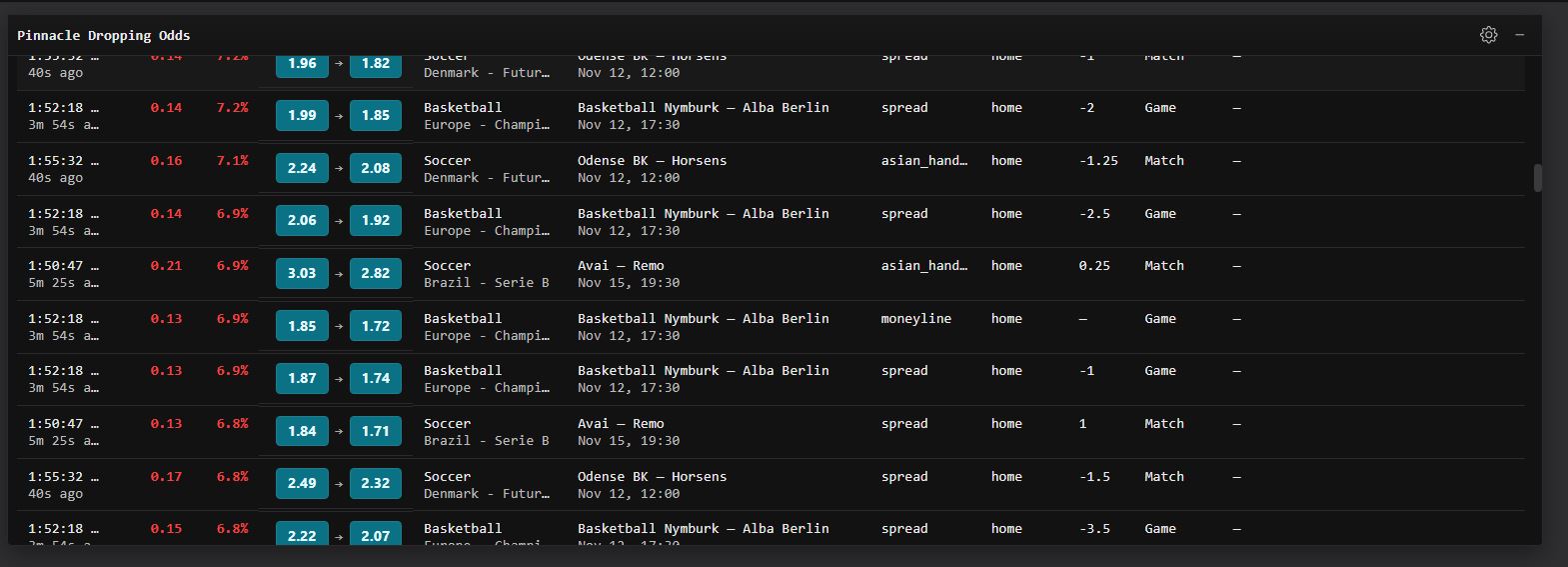
The dropping odds strategy is one of the most powerful value betting approaches available to sports bettors. By following the sharpest money in the market, you can identify mispriced odds before slower sportsbooks catch up. This strategy works for any sport where Pinnacle offers markets.
This top-down approach has been used by professional bettors and syndicates for years. With FairOdds Terminal, you can monitor these movements in real-time and act quickly on opportunities.
Unlike traditional handicapping, this approach requires no deep sports knowledge. You are not predicting outcomes — you are exploiting the gap between what sharp books know and what soft books have not yet priced in.
What is the Dropping Odds Strategy?
The Dropping Odds Strategy is a top-down sports value betting approach that involves monitoring the odds of a sharp sportsbook in order to find value bets on soft sportsbooks which are slower to adjust to new information that has entered the market.
Here's how it works in practice:
- Sharp sportsbooks like Pinnacle move their odds when new information enters the market
- This information could be large bets from pros, injury news, weather updates, or lineup changes
- Recreational sportsbooks copy Pinnacle's odds, but with a delay of 1–5 minutes
- During this window, you can place bets at the old (better) odds before they adjust
The key insight is that not all sportsbooks react to new information at the same speed. Sharp books like Pinnacle react instantly, while recreational books lag behind. That lag is where value lives.
Why Do Odds Drop? The 5 Main Causes
Understanding why odds move helps you evaluate the quality of each alert. Not every drop carries the same signal strength.
1. Sharp Money (Professional Bettors)
The most common cause. Professional bettors and syndicates place large, model-backed wagers. When Pinnacle accepts these bets, they immediately shorten the odds to reflect the updated true probability. Other books then copy this movement, but with a delay.
2. Injury and Lineup News
A key player ruled out 30 minutes before a match can trigger a sharp movement. Pinnacle traders react within seconds — soft books may take several minutes or until the next manual odds update cycle. Soccer and basketball are the most affected sports.
3. Steam Moves (Syndicate Bets)
Steam refers to rapid, coordinated betting by multiple accounts acting on the same market simultaneously. This creates a sudden spike in liability that forces immediate adjustment. Steam moves are typically the fastest to create cross-book opportunities because the velocity of the drop is very high.
4. Weather Conditions
In outdoor sports — golf, tennis, American football — sudden weather updates (strong wind, heavy rain) affect scoring models and trigger sharp adjustments, particularly to totals markets. These drops are high-quality because weather information is objective and well-modeled.
5. Opening Line Corrections
Sometimes Pinnacle opens a line that sharp bettors immediately identify as mispriced. This triggers an early correction. These drops carry strong signal — the market is self-correcting based on genuine probability, not noise.
The Sharpest Sportsbook: Pinnacle
Pinnacle is widely considered the sharpest sportsbook in the world. Other sportsbooks copy Pinnacle's odds because of this, but crucially they copy Pinnacle on a delay of up to a few minutes. The delay varies depending on the sportsbook and the specific market.
This delay gives quick bettors a window of opportunity to place value bets on slower sportsbooks before the odds adjust to reflect the new information that has entered the market.
Why is Pinnacle so sharp?
- They welcome winners: Pinnacle doesn't limit successful bettors, unlike most books
- High betting limits: They accept large bets, attracting professional action
- Low margins: Pinnacle operates with some of the lowest vigs in the industry
- Efficient markets: With high volume and sharp action, their odds are extremely accurate
- Market setter: Other sportsbooks use Pinnacle as the benchmark for setting their own lines
Key principle: When Pinnacle moves their odds, it's a strong signal that the true probability has changed. Other books will follow, but you can bet the old odds before they do.
How Sportsbooks Adjust Their Odds
Not all sportsbooks operate the same way. Understanding these differences helps you identify which books give you the most time.
Market leaders like Pinnacle employ large trading teams and sophisticated algorithms that respond almost instantly to new information. These sharp books move first when something changes.
Follower sportsbooks take a different approach. Many simply copy the lines of market leaders after a delay — they wait to see where the market is heading before adjusting. This is the lag that dropping odds bettors exploit.
Local and regional sportsbooks often move slowest. They focus on their specific markets and may lack resources to monitor everything globally. Their niche focus means they are often last to adjust odds on international events.
Certain events trigger more significant cross-book timing gaps:
- Injury news, especially for star players
- Weather updates in outdoor sports
- Starting lineup announcements
- Large syndicate bets hitting Pinnacle
Monitoring Dropping Odds in Real-Time
Because it's impossible to manually monitor thousands of Pinnacle odds waiting for a drop, you need software that does this for you. FairOdds Terminal displays dropping odds in real-time, allowing you to see movements as they happen and act quickly to place bets at slower sportsbooks.
The terminal shows all the critical information you need to identify value bets, including the exact price you need to beat for your bet to have positive expected value.
The terminal displays key data for each dropping odds opportunity:
- Event details: Teams, league, match time
- Market type: Moneyline, spread, totals, etc.
- Pinnacle's old odds: The odds before the drop
- Pinnacle's new odds: The current odds after the drop
- No Vig Price (NVP): The fair odds you need to beat
- Other sportsbooks: Current odds at recreational books
- Timestamp: When the drop occurred (speed matters)
Step-by-Step Execution: From Alert to Placed Bet
When an alert appears in the terminal, every second counts. Here is the exact execution sequence that separates consistent practitioners from those always one step behind.
Step 1 — Read the Alert (2–3 seconds)
The terminal shows the event, market, old odds, new odds, percentage drop, and No Vig Price (NVP). Absorb these numbers before touching anything else. The NVP is your decision threshold — you only bet if you can beat it at a soft book.
Step 2 — Check Your Soft Book Tabs (5–10 seconds)
Have 5–10 sportsbook accounts pre-loaded in browser tabs, already logged in and funded. Navigate to the same market at the slow books. You are looking for any odds still above the NVP.
Step 3 — Confirm Value (3–5 seconds)
If Soft Book A offers 1.85 and the NVP is 1.78, you have a +EV bet. If they only show 1.72, the opportunity has already closed there — move to the next tab. Never bet below the NVP regardless of how large the drop was.
Step 4 — Calculate Your Stake (2 seconds)
Use flat staking — 1–2% of bankroll per bet — for simplicity and speed. Decide your flat stake amount before starting each session, not during the alert window. The time pressure makes mid-bet Kelly calculations impractical.
Step 5 — Place the Bet (5–10 seconds)
Navigate to the bet slip, enter your stake, confirm. Do not deliberate about the outcome. You are executing a process, not predicting a result. Hesitation is what eats your execution window.
Step 6 — Record the Bet (10 seconds)
Log: event, market, odds taken, NVP at time of bet, which sportsbook, stake. This data becomes your feedback loop — it tells you which books are slowest and which markets give you the best edge over time.
Target execution time: under 30 seconds from alert to bet placed. Preparation before each session — accounts funded, tabs open, stake amount decided — determines whether you hit that target consistently.
Filter Settings to Find the Best Opportunities
Setting up filters correctly separates profitable alerts from noise. Here are the parameters that matter and the reasoning behind each.
Minimum Odds Drop: 5–8%
Below 5%, you are likely seeing line balancing rather than sharp information. A 5% drop from 2.00 to 1.90 represents meaningful market signal. Set higher (8–10%) if you prefer fewer, higher-confidence alerts or if you need more selective execution to protect account longevity.
Odds Range: 1.40 to 5.00
Very short odds (below 1.40) have small EV margins and require large samples to overcome variance. Long shots above 5.00 carry too much noise and unreliable price discovery. The 1.40–5.00 range gives the best risk-adjusted signal.
Time to Event: 2 to 48 Hours
Drops very close to game time (under 30 minutes) are often injury-triggered with high variance from lineup uncertainty. Drops far in advance (over 5 days) may move further before the event, eroding your edge. The 2–48 hour window captures the most reliable movements.
Sport-Specific Filter Settings
Soccer (major European leagues):
- Markets: Moneyline and Asian handicap
- Minimum drop: 5%
- Odds range: 1.50–4.00
- Focus: Premier League, La Liga, Serie A, Bundesliga, Champions League
Basketball (NBA, Euroleague):
- Markets: Moneyline and totals
- Minimum drop: 4% (higher volume means smaller drops are still informative)
- Odds range: 1.60–3.50
Tennis (ATP, WTA):
- Markets: Moneyline only
- Minimum drop: 7%
- Odds range: 1.30–4.50
- Best window: 4–48 hours before match start
Real Example of a Dropping Odds Value Bet
Let's break down a real-world example to see how this strategy works in practice.
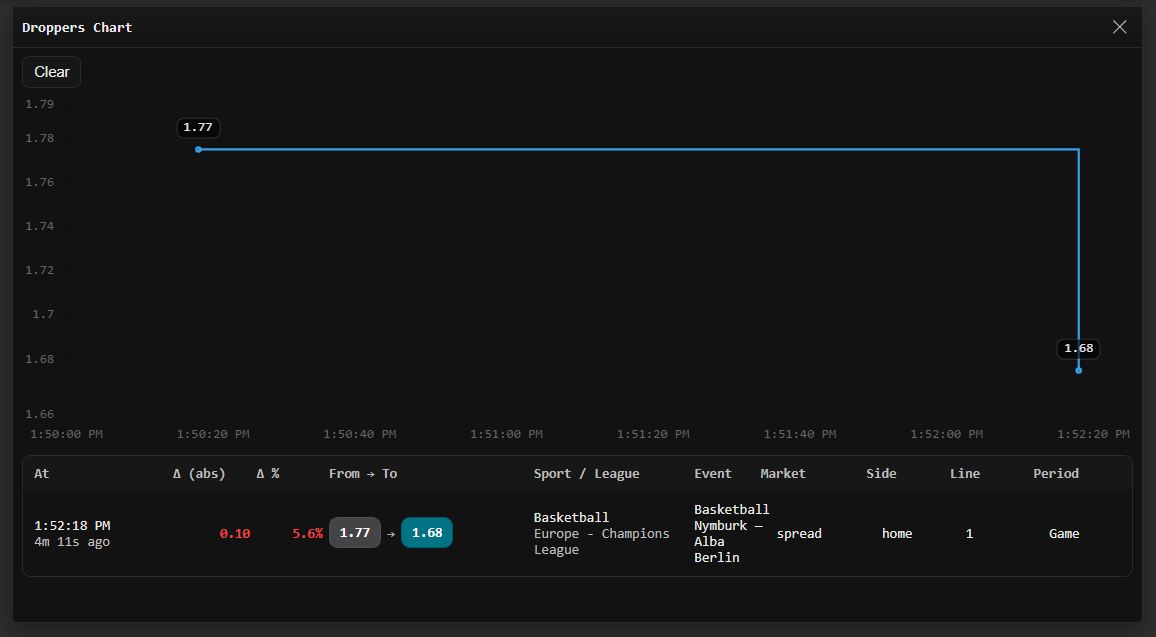
While monitoring the terminal, we spotted a basketball game in the Europe Champions League with a significant Pinnacle odds drop. Here's what happened:
- Event: Nymburk vs Alba Berlin (Basketball — Europe Champions League)
- Market: Spread, home team, line 1
- Initial Pinnacle odds: 1.77
- Pinnacle dropped to: 1.68 (5.6% drop)
This 5.6% drop signals that sharp money or new information entered the market. If a recreational sportsbook still offered 1.75 or higher on this spread and the No Vig Price was calculated around 1.70, this qualifies as a positive expected value bet.
Timeline breakdown:
- 1:50:00 PM — Sharp money hits Pinnacle: odds drop from 1.77 to 1.68
- 1:52:18 PM — Drop visible in terminal (4m 11s after drop)
- 1:52:30 PM — Check recreational sportsbooks for unchanged odds
- 1:52:45 PM — Bet placed at 1.75 (above NVP of 1.70)
- 1:55:00 PM — Slower sportsbooks copy Pinnacle and adjust their spreads
Even a 5.6% drop creates profitable opportunities when other sportsbooks are slower to react. The NVP at 1.70 was the filter — any book still showing 1.71 or above was worth betting.
Speed is everything: The window of opportunity typically lasts 1–5 minutes. Have your sportsbook accounts open and funded so you can place bets immediately when you spot favorable odds in the terminal.
A Second Example: American Odds on Unibet
Drops show up in whatever format your sportsbooks quote, including American odds. In one case from the terminal's 5-minute droppers list with a football filter, Pinnacle moved from +149 (2.41) to +117 (2.17) — a clear sharp signal — while Unibet still displayed +155 (2.55). We took Unibet, and the price was gone within minutes as Unibet caught up to the new line. The lesson is the same regardless of odds format: identify the lagging book fast, confirm it beats the No Vig Price, and execute before the gap closes.
The Price to Beat: No Vig Price (NVP)
In the basketball example above, the bet was only taken because the available price was above the No Vig Price (NVP). The terminal displays the NVP for each dropping odds opportunity, and it is vital that you only place a bet when the odds you are getting are higher than it.
The NVP is the single most important metric for identifying value bets.
What is No Vig Price?
The No Vig Price represents the fair odds after removing the bookmaker's margin (vig or juice). It's calculated by taking the market odds and eliminating the built-in profit margin that bookmakers charge.
- Betting above NVP = Positive expected value (+EV)
- Betting below NVP = Negative expected value (-EV)
- NVP gives you the exact threshold for profitability
Simple rule: Only bet when your available odds exceed the NVP. In the basketball example, NVP was 1.70 and the book offered 1.75 — that's a +EV bet. If they only offered 1.65, skip it entirely.
Closing Line Value: Why It Matters
Dropping odds bettors have a structural advantage beyond just catching movements — they consistently beat the closing line.
Closing Line Value (CLV) measures the difference between the odds you secured and the final odds just before the event starts.
When you catch dropping odds at 1.85 before they settle at 1.68, you have captured substantial CLV. This matters because the closing line represents the market's most informed assessment after all sharp money has flowed in.
Professional bettors track CLV for three reasons:
- Predictive power: Your average CLV percentage tends to approximate your long-term yield
- Faster feedback: CLV shows statistical significance after 50–65 bets; win/loss records require thousands
- Strategy validation: Consistent positive CLV confirms you are finding genuine value, not riding variance
Realistic EV Expectations
The dropping odds strategy works over large samples. Here is what you can realistically expect, and what you cannot.
Win rate: 48–52% on moneylines and spreads. You are not trying to win a high percentage — you are trying to win at odds that are better than the true probability implies.
ROI per bet: 2–5% is realistic for disciplined practitioners. Top performers with fast execution and 10+ active books typically average 3–4%.
Practical numbers:
| Bets/month | Avg stake | ROI | Monthly profit |
|---|---|---|---|
| 100 | €50 | 3% | ~€150 |
| 200 | €50 | 3% | ~€300 |
| 100 | €100 | 3% | ~€300 |
| 200 | €100 | 3% | ~€600 |
Variance is real: Even with a 3% edge, you will have losing weeks. Over 50 bets, variance dominates results. Over 500 bets, your edge becomes visible. Plan for at least 3 months of consistent activity before drawing conclusions about your strategy's performance.
Account longevity matters: A 3% edge across 15 active books is worth more than a 5% edge with 3 books that are about to limit you. Protecting your accounts through smart bet sizing, round stakes, and varied timing is as important as finding the edge in the first place.
Common Mistakes to Avoid
- Ignoring NVP: Betting just because odds dropped, without checking if your available price beats NVP
- Being too slow: Taking 5+ minutes to place a bet means odds have likely already adjusted everywhere
- Chasing every alert: Not all drops are equal. Focus on significant movements (5%+) with clear NVP upside
- Wrong stake sizing: Betting too much on individual alerts increases variance and triggers account limits faster
- Ignoring league quality: Lower leagues have less liquidity and less reliable price discovery
- Not tracking CLV: Failing to measure your Closing Line Value means you can't tell if your strategy is actually working
- Precise stake amounts: Exact stakes like €43.27 signal professional behavior to risk teams. Round to the nearest €5 or €10
- Frequent large withdrawals: Regular big withdrawals flag accounts as professional. Keep funds rotating between books instead
Advanced Techniques
Multi-Book Monitoring
Don't just check one recreational book. Have accounts at 5–10 sportsbooks and check all of them when you get an alert. Different books adjust at different speeds — learning which ones are consistently slowest is a durable competitive advantage.
Market Selection
- Best: Moneylines, totals, Asian handicaps
- Good: Main spreads, team totals
- Avoid: Exotic props, player props (too much variance, smaller soft-book coverage)
Combining with Arbitrage
Sometimes a dropping odds opportunity also creates an arbitrage situation if another book moves odds in the opposite direction. This gives you a guaranteed profit regardless of outcome — but these opportunities are rare and vanish in seconds.
Tools and Setup for Success
- Odds monitoring software: FairOdds Terminal displays Pinnacle movements in real-time
- Multiple sportsbook accounts: 5–10 recreational books with varying adjustment speeds
- Fast internet: Every second counts when placing bets
- Funded accounts: Pre-deposit at multiple books so you can bet immediately
- Bankroll management: 1–2% flat stakes per bet to handle variance from +EV betting
- Bet log: Spreadsheet or tracking tool to record odds, NVP, and closing odds for each bet
Ready to start following sharp money? Use the Pinnacle dropping odds tool for real-time line movements, or read the step-by-step manual for filter settings.
Dropping Odds Strategy FAQ
What is the dropping odds strategy?
The dropping odds strategy involves monitoring sharp sportsbook odds (primarily Pinnacle) for line movements, then quickly betting at slower recreational sportsbooks before they adjust their odds. This creates a window of positive expected value that typically lasts 1–5 minutes.
Why is Pinnacle considered the sharpest sportsbook?
Pinnacle is widely regarded as the world's sharpest sportsbook because they accept high limits, don't limit winners, and attract professional bettors. Their odds are the most efficient in the market, so other sportsbooks use Pinnacle's lines as their benchmark.
Why do odds drop?
Odds drop for five main reasons: sharp professional bettors placing large wagers, injury or lineup news, coordinated syndicate steam moves, weather updates affecting outdoor sports, and corrections of mispriced opening lines. Sharp money and injury news are the most common triggers.
How do I monitor dropping odds?
FairOdds Terminal displays Pinnacle odds movements in real-time. When Pinnacle's odds drop significantly, you see the old odds, new odds, and the No Vig Price (NVP) you need to beat at other sportsbooks for a positive expected value bet.
What is No Vig Price (NVP)?
No Vig Price is the fair odds after removing the bookmaker's margin (vig). You should only place a bet when the odds you're getting are higher than the NVP. It's the most important metric for determining if a bet has positive expected value.
How fast do I need to act on dropping odds alerts?
Speed is critical. Recreational sportsbooks typically copy Pinnacle's odds within 1–5 minutes. Target under 30 seconds from alert to bet placed by pre-funding accounts, keeping all tabs open before your session begins, and deciding your stake size in advance.
What ROI can I realistically expect?
Disciplined practitioners typically achieve 2–5% ROI per bet over large samples. Results stabilize after 500+ bets — variance dominates smaller samples. With 200 bets per month at €50 average stake and 3% ROI, expect roughly €300 per month after the strategy matures over several months.
Which sports work best for dropping odds strategy?
Soccer, basketball, and tennis offer the best volume and the most recreational sportsbooks that are slow to adjust. Soccer Asian handicaps and basketball totals are particularly reliable. Avoid exotic props and lower-division leagues with thin liquidity.
Is dropping odds the same as steam chasing?
Yes, dropping odds strategy is also called steam chasing or following sharp money. The term 'steam' refers to sudden, sharp line movements caused by professional bettors or syndicates placing large wagers on the same market in a short time window.
Can I use dropping odds strategy for live betting?
Yes, but live betting odds drop extremely fast. Pre-game dropping odds provide a better window of opportunity for most bettors. Live dropping odds require exceptional speed and often automated tools to capitalize effectively.
Will sportsbooks limit my account?
Eventually, yes. Most recreational sportsbooks limit consistent winners after weeks or months. This is why maintaining 5–10 active accounts matters — losing one book doesn't stop you. Bet sizing, round stakes, and timing variation can meaningfully extend account lifespans.