What Is Arbitrage Betting? Complete Arbing Guide
Arbitrage betting (arbing) means placing bets on all possible outcomes of an event across different bookmakers and locking in a guaranteed profit — regardless of the result.

Arbitrage sounds too good to be true. It is not. It is pure math. When two bookmakers disagree on the probability of an outcome by more than the combined vig they each charge, covering both sides locks in a risk-free profit. The challenge is finding those gaps quickly enough — and knowing how to stay in the game once bookmakers notice you are winning.
This guide covers everything: how two-way and three-way arbs work with real numbers, how to size stakes, bankroll requirements, why Pinnacle is the right sharp-side book, when and how fast to act, and how to handle account limitations over the long term.
Why Arbitrage Opportunities Exist
Each bookmaker sets its own odds independently. They employ traders and algorithms, but they do not always agree on the true probability of an outcome. Sometimes one book is slow to react to injury news, a steam move, or simply has a different line than a rival.
When the combined implied probabilities across all legs of a market at different books add up to less than 100%, that is an arbitrage — you can cover every outcome for less than the total payout, guaranteeing a profit. These gaps are typically 1–3% and usually close within minutes once enough arbers identify and exploit them.
Two-Way Arbitrage: Worked Example
The simplest arb is a two-outcome market — Over/Under totals or moneylines without a draw.
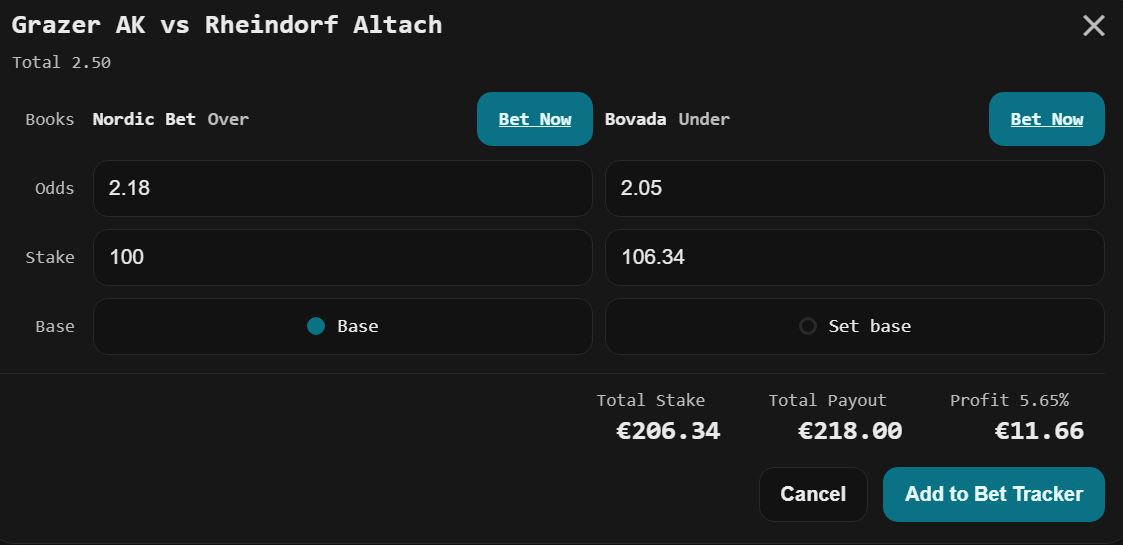
Example: Grazer AK vs Rheindorf Altach — Total 2.5 goals
- NordicBet: Over 2.5 at odds 2.18
- Bovada: Under 2.5 at odds 2.05
You want both legs to pay out the same amount regardless of which side wins. Start with a €100 stake on the Over:
- Stake on Over: €100 — payout if Over wins: €218.00
- Stake on Under: €218.00 ÷ 2.05 = €106.34 — payout if Under wins: €218.00
Total staked: €206.34. Guaranteed payout: €218.00. Profit: €11.66 (5.65% ROI) — no matter which side wins.
Use an arbitrage calculator to do this arithmetic instantly for any pair of odds.
Three-Way Arbitrage (1X2 Markets)
Football and other sports with three outcomes (home win, draw, away win) require covering all three legs across three different bookmakers. The principle is identical — equalize the payout on every possible result.
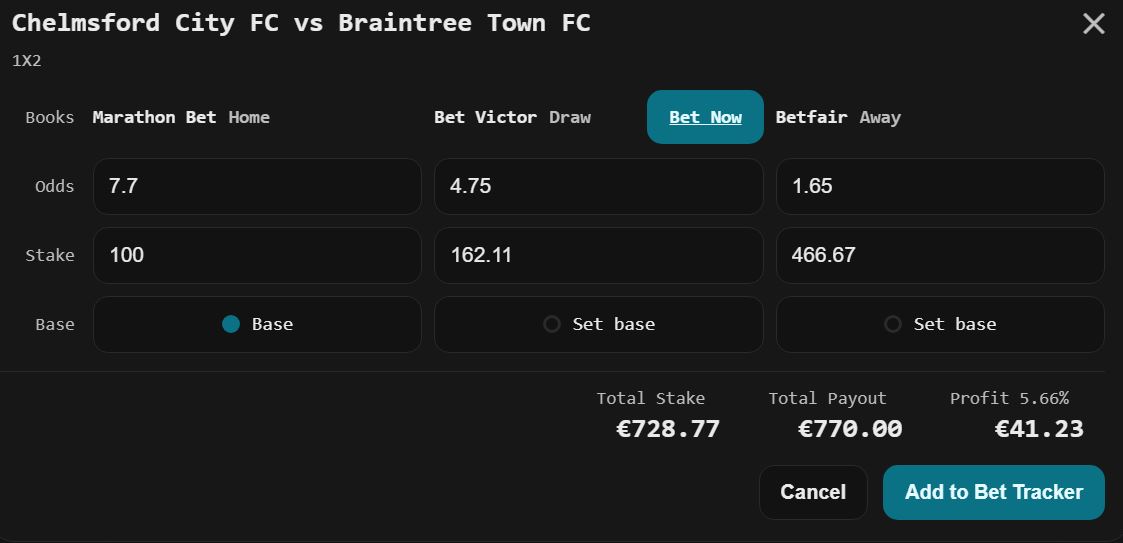
Example: Chelmsford City vs Braintree Town — 1X2
- Book A: Home win at 3.10 → stake €100
- Book B: Draw at 3.20 → stake €96.88
- Book C: Away win at 3.30 → stake €93.94
All three legs pay approximately €310. Total staked: €290.82. Guaranteed profit: ~€19.18 (6.6% ROI). The arbitrage calculator finds the exact stakes automatically.
Line Movement Arbitrage
A third type requires no simultaneous opportunity. You place one side of a bet, then the market moves enough that hedging the other side also becomes profitable.
How it works: You bet Over 2.5 at 2.18 for €100 (payout €218.00 if Over hits). Later the line shifts and Under 2.05 appears at another book. You hedge: stake €218.00 ÷ 2.05 = €106.34 on Under. Both outcomes now pay €218.00. Total staked €206.34, profit €11.66 — locked in.
This is the least common arb type but worth watching, particularly in live betting where lines move quickly.
Bonus Arbitrage: The Highest-ROI Variation
Deposit bonuses dramatically improve arb returns because one leg of the bet is covered with bonus funds rather than cash. Your out-of-pocket risk drops while the profit target stays the same.
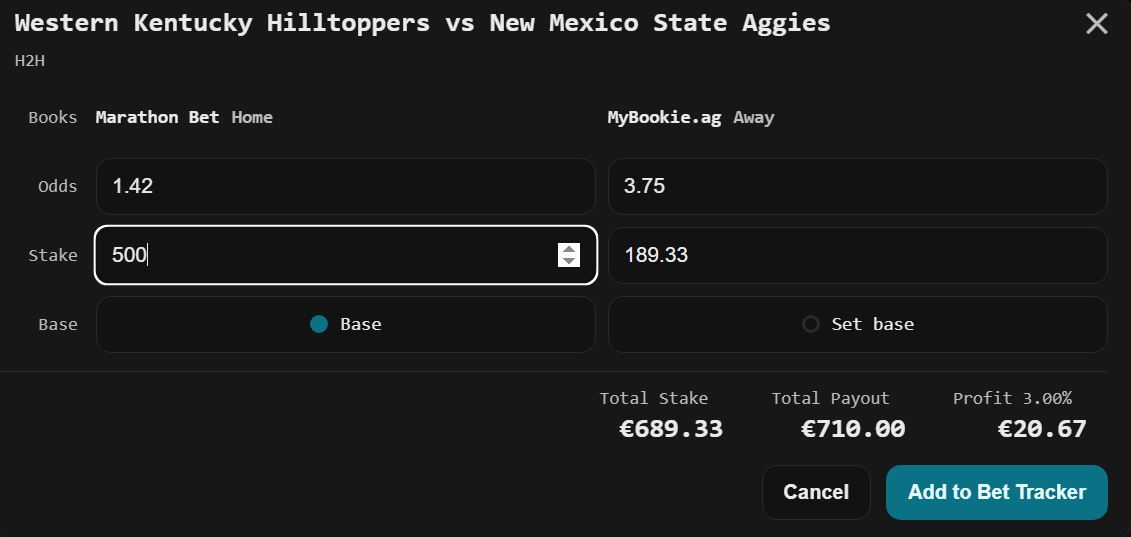
Example: You have a €500 deposit bonus on Marathonbet. Game: Western Kentucky (1.42) vs New Mexico State (3.75).
- Leg 1: €500 on Western Kentucky at 1.42 (bonus funds) → payout €710.00
- Leg 2: €710.00 ÷ 3.75 = €189.33 cash on New Mexico State at MyBookie → payout €710.00
Total cash out-of-pocket: €189.33. Guaranteed profit: ~€20.67. Effective ROI on cash at risk: 10.9% — far above the 2% you would see without the bonus. Always read rollover conditions before executing a bonus arb.
Bankroll Requirements
Arbitrage is linear. A 1.5% average return on a €1,000 stake produces €15 profit per bet. The same rate on a €10,000 stake produces €150. Below €2,000 total bankroll, the absolute profit per bet is so small that the account management effort — funding multiple books, tracking bets, handling limitations — is hard to justify.
| Starting Bankroll | Avg Profit per Arb (1.5%) | Realistic Use Case |
|---|---|---|
| €500–€1,000 | €7–€15 | Learning the mechanics; better to use value betting instead |
| €2,000–€3,000 | €30–€45 | Supplemental income, part-time |
| €10,000–€15,000 | €150–€225 | Serious monthly income potential |
| €20,000+ | €300+ | Professional-level returns |
If your bankroll is under €2,000, start with positive EV value betting — it requires less capital to generate meaningful returns and has a shallower learning curve.
Why Pinnacle Is the Ideal Sharp-Side Book
Every two-way arb needs two books: one on each side. The sharp-side book is the one where you always know your bet will be accepted and never limited. Pinnacle has fulfilled this role since 1998.
- No limits on winners. Pinnacle has never restricted a profitable bettor. They view sharp action as valuable data that improves their line accuracy.
- Highest limits in the industry. You can stake large amounts on Pinnacle without worrying about bet refusal.
- Lowest margins. Pinnacle's vig is typically 1–2% versus 5–10% at soft books. Better odds mean more arbs clear the profitability threshold.
- Reliable payouts. Operational since 1998 with a clean payout record.
Country-specific state-licensed monopolies (Veikkaus in Finland, Svenska Spel in Sweden) share similar characteristics — they do not limit players and carry high bet limits. If you have access to one of these, combine it with Pinnacle as your two permanent sharp-side anchors.
Best Times for Arbitrage Opportunities
Thursday to Sunday is prime time. The reason is volume: the more games scheduled, the more lines bookmakers must manage simultaneously, and the more pricing gaps appear. Major soccer leagues, NHL, NBA, and NFL fixtures are concentrated on weekends, generating the most arb traffic.
Monday to Wednesday has significantly fewer games — especially in soccer — and therefore fewer opportunities. Many experienced arbers treat weekdays as preparation time: fund accounts, review limits, review tools. Execution happens Thu–Sun.
Speed Is Non-Negotiable
Most arbitrage opportunities close within 2–5 minutes. The mechanism: once a mispriced line appears, arbers pile bets onto the mispriced side. The soft book's exposure grows, risk software flags it, and the odds are corrected. On major markets (Premier League, NFL primetime), this can happen in under a minute.
Manual scanning across bookmaker websites is too slow. Dedicated arb-scanning software monitors 200+ bookmakers simultaneously and sends an alert the instant a gap appears. Your job is to act on that alert — clicking through to the soft book, placing the stake, then confirming the sharp side — in under 30 seconds on markets you know well.
Avoiding Account Limitations
Soft bookmakers will eventually limit arbers. This is guaranteed and expected — every arb bet is a certain loss for the soft book. It is the same dynamic as a casino limiting card counters: the house has every incentive to block strategies that guarantee their loss.
How to extend your operational life at soft books:
- Spread stakes across many books. Having 10–15 soft accounts means any one limitation only reduces your capacity by 7–10%, not 50%.
- Do not immediately stake the maximum on a new account. Build up gradually. Accounts that look recreational last longer before triggering risk systems.
- Include some recreational-looking bets. Mixing in a few small parlays or popular event bets on limited accounts can slow the restriction process.
- Use clone bookmakers. Many soft bookmakers share a platform under different brand names. Unibet, Mr. Green, and 32Red are the same platform. If Unibet limits you, transfer funds to 32Red and continue. Check the bookmakers page for the full clone map. Read the complete guide on avoiding bookmaker limitations.
Arbitrage vs Value Betting: Which to Choose
Both strategies exploit bookmaker pricing errors. The key difference is certainty: arbitrage locks in profit on every single bet; value betting produces profit over a large sample but carries variance — individual bets win and lose.
| Aspect | Arbitrage Betting | Value Betting |
|---|---|---|
| Profit certainty | Guaranteed on every bet | Long-term positive, short-term variance |
| Average return per bet | 1–2% | 3–8% (higher but uncertain) |
| Minimum bankroll | €2,000–€3,000 | Can start with less |
| Execution speed | Must act in minutes | More flexible |
| Account limitations | Inevitable at soft books | Also inevitable, slightly slower |
| Bankroll graph | Smooth linear growth | Upward trend with swings |
| Best for | Larger bankrolls, low-risk preference | Any bankroll, higher long-term ROI |
Many experienced bettors run both in parallel: arbitrage for predictable linear gains, value betting for higher total returns. The two strategies share the same infrastructure — multiple soft accounts, a Pinnacle reference price, and scanning software — so running both simultaneously adds relatively little overhead once you are set up.
Getting Started: 7-Step Checklist
- Build your bankroll to €2,000–€3,000 minimum before committing to arb as your primary strategy.
- Open a Pinnacle account (and any country-specific no-limit book you have access to) as your permanent sharp-side anchor.
- Open 8–12 soft bookmaker accounts and fund them. Prioritize books with high limits and those that are not clones of each other.
- Use arb-scanning software with real-time alerts. Manual scanning is too slow.
- Focus on Thursday–Sunday for maximum opportunity volume.
- Act within 30 seconds of an alert on familiar markets.
- Track every bet. Log the odds, books used, stake, and result. Knowing which books limit you fastest lets you prioritize accordingly.
Arbitrage Betting FAQ
What is arbitrage betting?
Arbitrage betting (also called sure betting or arbing) means placing bets on all possible outcomes of an event across different bookmakers at odds that guarantee a profit regardless of the result. The profit comes from the gap between two bookmakers' prices — one has priced an outcome too high relative to the other. When that gap exceeds the combined vig, a risk-free profit locks in.
Why do arbitrage opportunities exist?
Bookmakers price markets independently. Occasionally one book moves a line faster than another, or makes a temporary pricing error. The gap between their prices is the arbitrage. These gaps are usually small (1–3%) and short-lived — other arbers and bookmaker risk teams close them within minutes.
How does two-way vs three-way arbitrage work?
Two-way arbs cover both sides of a two-outcome market (Over/Under, moneyline without a draw) across two bookmakers. Three-way arbs cover all three 1X2 outcomes (home win, draw, away win) across three bookmakers. In both cases stakes are sized so the payout is identical regardless of which outcome wins.
How do I size stakes to guarantee a profit?
The goal is to equalize the payout on all legs. For a two-way arb: Stake on Leg 2 = (Stake on Leg 1 × Odds of Leg 1) ÷ Odds of Leg 2. For three-way arbs use an arbitrage calculator — it handles the math instantly and tells you exactly how much to stake on each bookmaker.
What bankroll do I need to start arbitrage betting?
The minimum recommended starting bankroll is €2,000–€3,000. Arbitrage is linear — a 1.5% average return on €1,000 stakes is €15 per bet, while the same rate on €10,000 stakes is €150. Below €2,000 the absolute returns per bet are too small to justify the effort. If your bankroll is under €2,000, start with value betting and build up first.
Why is Pinnacle the ideal bookmaker for arbitrage?
Pinnacle never limits or bans winning players, offers the highest betting limits of any mainstream bookmaker, and has the lowest margins in the industry. Their business model welcomes sharp action because winning bettors help them set more accurate lines. Using Pinnacle as your sharp-side book means one leg of every arb is safe from limitation.
When are the most arbitrage opportunities available?
Thursday to Sunday are the most active days. That is when the most sports games are scheduled, the most volume moves through bookmakers, and the most pricing discrepancies appear. Monday to Wednesday have significantly fewer games and therefore fewer arb opportunities.
How long does an arbitrage opportunity last?
Most arb windows last only a few minutes. Once enough arbers have placed bets on the mispriced side, the bookmaker closes the gap. Using software with real-time alerts is essential — manually scanning odds is too slow to catch most opportunities.
Will bookmakers limit my account for arbitrage betting?
Soft bookmakers will eventually limit arbers because every arbitrage bet is a guaranteed loss for them. This is expected and manageable. Use sharp books (Pinnacle) that never limit, spread stakes across many soft accounts, use clone bookmakers when one gets restricted, and build accounts up gradually rather than staking maximums immediately.
Is arbitrage betting legal?
Arbitrage betting is legal in virtually all jurisdictions where sports betting itself is legal. Bookmakers may choose to limit or close accounts under their terms of service, but that is a business decision, not a legal matter. Always verify that sports betting is permitted in your jurisdiction.
How do bonuses improve arbitrage returns?
When one leg of an arb is covered with a deposit bonus, your out-of-pocket cash stake drops dramatically while the profit target stays the same. A €500 deposit bonus covering one side of a two-way arb can turn a 2% nominal ROI into an effective 10%+ return on actual cash risked. Always check rollover requirements before executing bonus arbs.