What Is Positive EV Betting? How to Find +EV Bets
Positive EV betting means only wagering when the math is on your side. This guide explains the concept, the formula, and how to put it into practice.

Most sports bettors lose long-term — not because they pick bad teams, but because they bet without an edge. Positive EV betting fixes that. Instead of betting on hunches or favorites, you only bet when the offered odds are higher than they should be based on the true probability. Do that consistently and profit follows over a large enough sample.
This guide covers everything: what positive EV means, how to calculate it, how to find +EV bets, how to size stakes, and what to realistically expect from the strategy.
What Is Positive EV Betting?
Expected Value (EV) is the average result of a bet if it were placed thousands of times under identical conditions. A bet has positive expected value when the true probability of winning is higher than what the bookmaker's odds imply.
Bookmakers build a margin — called vig or juice — into every market. A standard two-way market might price both sides at odds that imply a combined 106% probability. That extra 6% is the bookmaker's edge. If you bet randomly into those markets, you lose 6% on average over time.
Positive EV betting flips this. Instead of accepting the bookmaker's implied probability, you find situations where the offered price is better than what the true probability warrants — and those situations do exist, because not all bookmakers price every market identically.
The Vig: Why the House Wins by Default
Think of it like buying and selling ten-euro notes. A currency trader might buy for €9.60 and sell for €10.40, pocketing an €0.80 spread on every transaction. That spread is their guaranteed income regardless of which direction the underlying value moves.
Sportsbooks do the same thing with odds. They price every market so the combined implied probabilities add up to more than 100%, and they take a cut of every wager placed. The only way to beat this is to find the specific bets where the offered odds exceed the true probability — that is what positive EV betting is about.
How to Calculate Expected Value — With Examples
The EV formula is straightforward:
EV = (Probability of Winning × Profit if Win) − (Probability of Losing × Stake)
Example 1: Football Match
You estimate a team has a 60% chance of winning. A bookmaker offers decimal odds of 2.00 (even money), meaning you win €100 profit on a €100 stake.
- Probability of winning: 60% (0.60)
- Probability of losing: 40% (0.40)
- Profit if win: €100
- Loss if lose: €100
EV = (0.60 × €100) − (0.40 × €100) = €60 − €40 = +€20
This bet has positive expected value of €20 per €100 staked. Place it 100 times and the law of large numbers expects you to be up €2,000.
Example 2: Basketball Game
After analysing form and injury news, you estimate Team A has a 55% chance of winning. The bookmaker offers +200 (decimal 3.00) — a €100 bet wins €200 profit.
EV = (0.55 × €200) − (0.45 × €100) = €110 − €45 = +€65
That is a large edge — 65% of your stake as expected profit. In practice edges this large are rare and usually fleeting, but the calculation principle is identical for any size edge.
When EV Is Negative
Reverse the numbers: you estimate the team has only a 40% chance of winning but bet at 2.00. EV = (0.40 × €100) − (0.60 × €100) = −€20. This is a negative EV bet. Even if you win this one, placing it repeatedly loses money over time.
Why EV in Sports Betting Is Always Theoretical
Unlike poker — where a deck has exactly 52 cards and probabilities can be calculated precisely — sports outcomes involve human uncertainty that no model fully captures. Injuries, refereeing decisions, weather, and individual performance swings all affect results in ways that are impossible to quantify perfectly.
This means your calculated EV is an estimate, not a guarantee. Your true edge might be slightly higher or lower than the number your model or tool produces. Two implications follow:
- Sample size matters enormously. A 3% theoretical edge can look like a loss over 50 bets and only becomes visible over several hundred.
- Bet sizing must account for model uncertainty. Full Kelly sizing assumes your edge estimate is exact. Because it rarely is, fractional Kelly (sizing at 25–50% of full Kelly) is safer.
How to Find +EV Bets: Two Methods
Method 1: Market-Based (Sharp vs Soft Book Comparison)
This is the most accessible method for most bettors. The logic: some bookmakers price markets more accurately than others. Sharp bookmakers — those that accept large stakes from professional bettors and adjust lines based on informed money — produce the most accurate odds in the market. Pinnacle and Betfair Exchange are the benchmark sharp books in most sports.
Soft bookmakers price markets independently and sometimes misprice relative to the sharp consensus. When a soft book offers odds on a team at 2.40, but the sharp book's no-vig price implies the fair price is only 2.10, that gap represents potential value.
In practice: take the sharp book's price, remove the vig using a no-vig calculator to get the true implied probability, then compare that probability to the soft book's offered odds. If the soft odds imply a lower probability than the true probability, you have a +EV bet.
Method 2: Projections-Based Modeling
This method builds probability estimates from raw data: team ratings, player statistics, historical matchup trends, weather, travel schedules. If your model says a team has a 65% win probability and the market offers odds implying 55%, the bet is +EV by your model's estimate.
The challenge: building a projections model that consistently outperforms the sharp market is difficult. Sharp bookmakers employ quant teams. For most bettors, market-based methods are more practical and already proven to generate edge when applied consistently.
Sharp vs Soft Bookmakers: Why the Gap Exists
Sharp bookmakers adjust their lines quickly when informed money comes in. If a professional syndicate bets heavily on Team A, Pinnacle's odds on Team A shorten within minutes. Soft bookmakers either react more slowly or are less exposed to sharp money and therefore maintain the old price longer.
This creates the window where +EV bets appear. The window is often short — sometimes minutes, sometimes hours for markets that are less efficient. Speed matters, particularly for heavily traded markets like major-league moneylines.
| Feature | Sharp Bookmakers | Soft Bookmakers |
|---|---|---|
| Stake limits | High | Low to medium |
| Margin | Low (1–2%) | Higher (5–10%) |
| Winning bettors | Welcome (help pricing) | Often restricted |
| Line movement speed | Fast | Slower |
| Role for +EV bettors | Price reference (true probability) | Where you actually bet |
Step-by-Step: Placing a Positive EV Bet
Once you understand the concept, execution is fast. Here is how a typical +EV bet unfolds:
Step 1 — Set Your Filters
Open the Positive EV tool and configure which bookmakers you have funded accounts at, a minimum EV percentage (most bettors start at 2–3%), and an odds range. Lower odds (1.40–2.50) have less variance; higher odds (3.00+) swing more per bet but carry the same expected value if the edge is real.

Step 2 — Find the Opportunity
The tool surfaces bets sorted by edge percentage. The soft odd — the one that is mispriced relative to the sharp market — is highlighted. You can see the market at a glance: what the sharp book prices the bet at, what the soft book offers, and the gap between them expressed as an EV percentage.

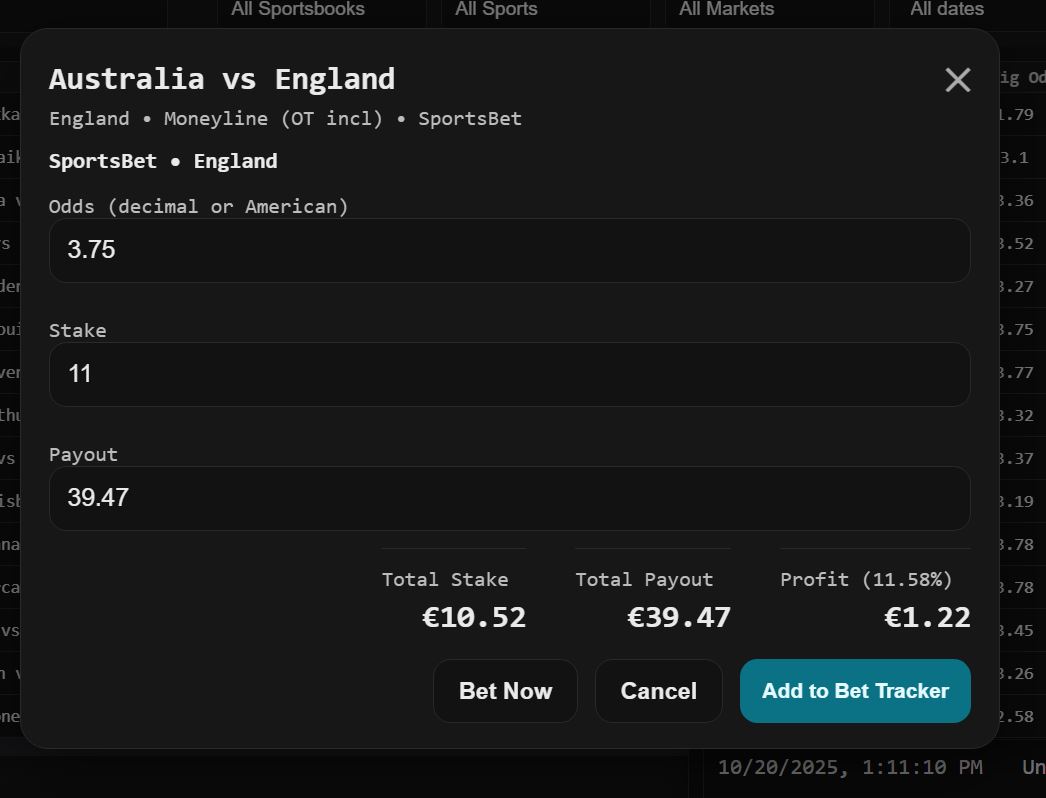
In the example above, Australia vs England at 3.75 on a soft book is the top opportunity. The sharp market implies this outcome is worth roughly 3.30. That gap is the edge.
Step 3 — Act Quickly
Soft bookmakers adjust their lines as volume comes in. An opportunity that shows 5% EV at 9:00 AM may be down to 1% by 9:05 AM on popular markets. Have your accounts pre-funded and tabs open for the books you use most. The full execution — from seeing the alert to having the bet confirmed — should take under 30 seconds on familiar markets.
Step 4 — Record and Track CLV
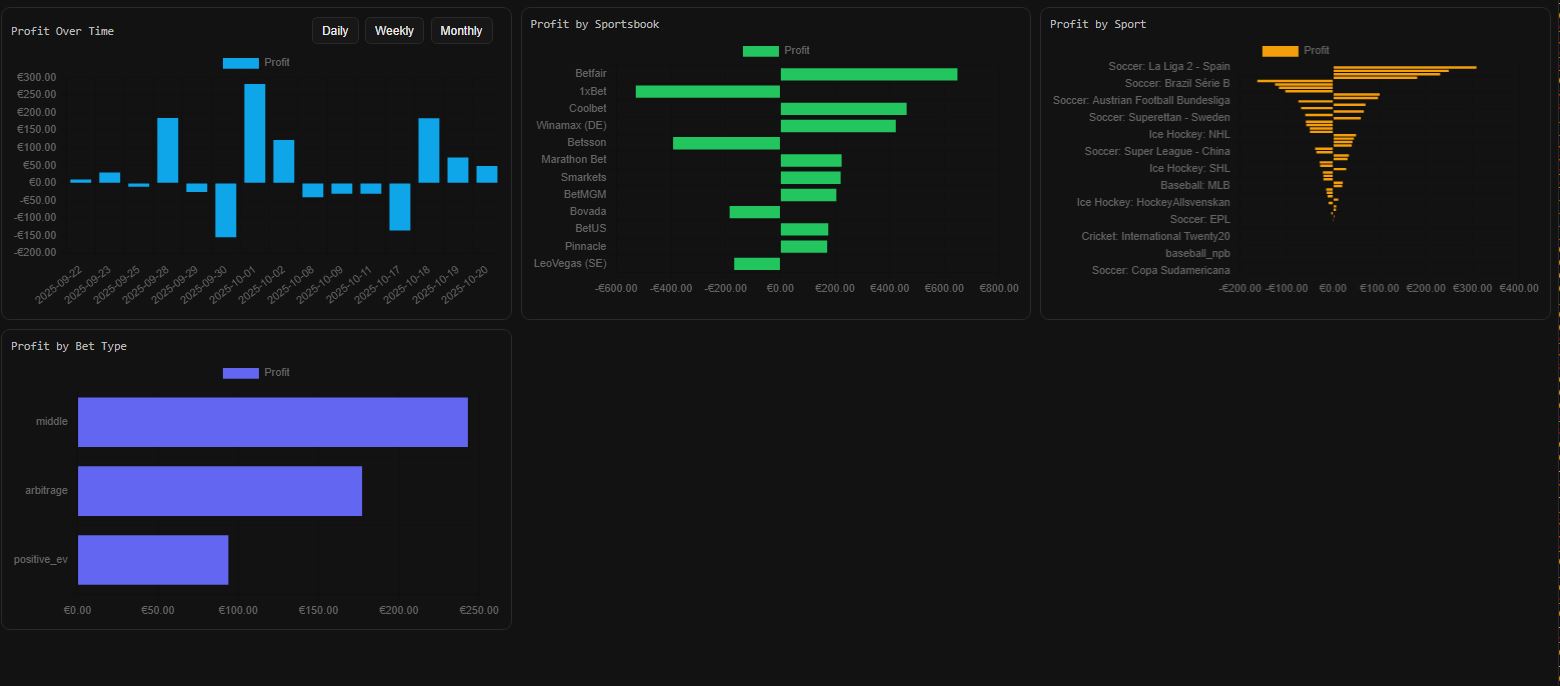
Log every bet: the odds you got, the closing odds, the edge shown by the tool, and the result. The most important column is closing line value (CLV) — whether the odds you bet at were better than where the market closed. Consistent positive CLV is the clearest early signal that your process is working, even during losing runs. Results alone tell you nothing over a small sample.
Bet Sizing: Flat Staking vs Kelly Criterion
How much to stake per bet is as important as finding the bet in the first place. Two main approaches:
Flat Staking
Bet the same amount on every bet regardless of edge size. Simple to execute, keeps variance predictable, and prevents over-betting on a bet where your edge estimate turns out to be wrong. The downside: you leave growth on the table when you spot a genuinely large edge.
A practical flat stake: 1–2% of your total bankroll per bet. This gives you sufficient volume to handle variance without risking ruin during a bad run.
Kelly Criterion (Fractional Kelly)
Kelly sizes the stake based on your estimated edge and the odds. The formula: Kelly % = (Edge / (Odds − 1)). A 4% edge at odds of 2.00 suggests staking 4% of bankroll (full Kelly). Most bettors use 25–50% of full Kelly — called fractional Kelly — to reduce drawdowns without abandoning the principle that larger edges deserve larger stakes.
Key caveats for Kelly:
- Small edges require large volume, not large stakes. A 1% edge at fractional Kelly produces tiny individual bets — that is correct. The profit comes from quantity, not size.
- Your edge estimate is an approximation. If you think your edge is 5% but it is actually 2%, full Kelly will over-bet significantly. Fractional Kelly provides a buffer.
- Never bet more than 5% of bankroll on any single +EV bet, regardless of what Kelly suggests, unless you have extremely high confidence in the model.
Why Line Shopping Multiplies Your Edge
Getting the best available price on every bet is not a minor optimization — it is essential. Consider this:
You estimate your true edge on a bet is 3%. You consistently take prices that are 2% below the best available because you are not checking all your books. Your real edge is now 1%. Three times the work for one-third of the return.
Conversely, if you always get the best available price, you sometimes discover the true edge is larger than the tool shows — because the soft book hasn't adjusted yet and is offering even more than the initial alert indicated.
Practical line shopping tips:
- Keep accounts funded at 6–8 soft bookmakers so you can always take the best price
- Use the +EV tool as your starting point, then glance at other soft books for the same market before clicking accept
- Spreads on exchange markets (Betfair, Smarkets) sometimes beat even the best soft book on popular events
The Main Challenges of +EV Betting
Variance and Sample Size
The most common reason bettors abandon +EV strategies: they have a losing month and conclude "the system doesn't work." In reality, variance over 50–100 bets is enormous. A genuine 4% edge can produce a losing month. A losing season is possible with a 2% edge. The strategy only proves itself over hundreds of bets.
Track CLV, not results, until you have at least 500 bets logged. CLV tells you whether your process is sound before the sample is large enough for results to be meaningful.
Account Limitations
Soft bookmakers restrict accounts that show consistent winning patterns. This is their right and it is expected. Strategies to slow the process:
- Spread action across many soft books so no single book sees enough volume to flag you quickly
- Avoid betting the maximum immediately on new accounts — build up gradually
- Include some bets on popular markets with public action — bets that look recreational
- When accounts do get limited, move on and open new ones; the book pool is large enough to sustain +EV betting for years
Market Efficiency on Popular Events
Major-league moneylines on primetime games are among the most efficient markets in sports betting. +EV opportunities there are short-lived and competitive. Better edges typically appear in lower-profile markets, second-tier leagues, player props, and live betting — markets where sharp money takes longer to arrive and soft books are slower to adjust.
Realistic Expectations
What should you actually expect from a disciplined +EV betting approach?
| Average Edge | Bets per Month | Monthly ROI | Bets to See Stable Results |
|---|---|---|---|
| 1–2% | 300+ | 3–6% on stakes | 1,000+ |
| 3–5% | 200+ | 6–10% on stakes | 300–500 |
| 5–8% | 100+ | 5–8% on stakes | 200–300 |
These numbers assume you are consistently finding real edge — not just betting any bet the tool shows. Filter quality, stake discipline, and fast execution all affect where your actual ROI lands. Most beginners overestimate their edge and underestimate how long variance lasts.
Common Mistakes to Avoid
- Chasing losses with larger stakes. Variance causes losing streaks on legitimate +EV bets. Raising stakes to recover faster destroys bankroll management and risks ruin.
- Betting too low an EV threshold. A 0.5% edge barely covers the chance that the tool's reference book had stale odds. Set a minimum of 2–3% until you have tested your process.
- Ignoring speed. An alert that shows 6% EV at posting and 1% by the time you bet it was not a 6% EV bet — it was a 1% EV bet. Speed directly determines the edge you actually capture.
- Not tracking CLV. Without tracking whether you beat the close, you cannot tell whether your profits reflect a real process or lucky variance. Blind betting without records is gambling, not +EV betting.
- Over-concentrating on one bookmaker. A single account restricted after 200 bets is a significant setback. Spreading across 8–10 books from the start means one restriction barely slows you down.
Positive EV Betting FAQ
What is positive EV betting?
Positive EV betting means placing bets only when the offered odds imply a higher payout than the true probability warrants. If a bet has a 55% chance of winning but the odds only require a 50% win rate to break even, the bet has positive expected value. Over hundreds of bets, positive EV bets generate profit even though individual results vary.
How do you calculate expected value in sports betting?
EV = (Probability of Winning × Profit if Win) − (Probability of Losing × Stake). Example: you estimate a team has a 60% chance of winning at decimal odds of 2.00 (even money). EV = (0.60 × €100) − (0.40 × €100) = €60 − €40 = +€20. That bet has positive expected value of €20 per €100 staked.
How do you find +EV bets?
The most reliable method is market-based: compare the no-vig price at a sharp bookmaker (Pinnacle, Betfair exchange) to the price offered at a soft bookmaker. If the soft book offers significantly higher odds than the sharp book implies, that is a +EV opportunity. Automated scanners do this comparison across 200+ books in real time.
What is the difference between a sharp and a soft bookmaker?
Sharp bookmakers (Pinnacle, Betfair exchange) accept large stakes from winning bettors and price markets accurately. Soft bookmakers cater to recreational bettors, accept lower limits, and sometimes misprice lines relative to the sharp market. The gap between a sharp book's price and a soft book's price is where +EV opportunities appear.
Is expected value guaranteed in sports betting?
No. EV is always theoretical in sports betting. Unlike poker with a fixed 52-card deck, sports outcomes involve human uncertainty that cannot be fully modelled. Your calculated edge is an estimate, not a guarantee. This is why sample size matters: a 3% edge needs hundreds of bets before results reliably reflect the edge.
What is flat staking vs Kelly Criterion for +EV betting?
Flat staking means betting the same fixed amount on every bet regardless of edge size. It is simple and reduces variance. Kelly Criterion sizes the bet based on edge and odds, betting more when edge is larger. Most bettors use fractional Kelly (25–50% of full Kelly) to reduce drawdowns while still scaling with edge strength.
Why does line shopping matter for positive EV betting?
Even a small difference in odds compounds significantly over hundreds of bets. If your estimated edge is 3% but you consistently take odds 2% worse than the best available price, your real edge is only 1%. Getting the best available odds on every bet is not optional — it is how you protect and maximise the edge you found.
How much volume do you need for +EV betting to show results?
The smaller your edge, the more bets you need for results to reflect it. A 5% edge becomes visible after roughly 200–500 bets. A 1–2% edge may require 1,000+ bets. Most bettors underestimate variance and give up before the sample size is large enough. Track closing line value (CLV) instead of results — it tells you whether your process is working before the sample is large.
What is Closing Line Value and why does it matter?
Closing Line Value (CLV) measures whether the odds you bet at were better than the odds the market closed at. If you consistently beat the close, your process is finding real edge — even during losing runs. CLV is the most reliable early indicator that your +EV bets are genuine and not just lucky picks.
Will bookmakers limit my account for positive EV betting?
Soft bookmakers do restrict winning bettors. To slow this down: spread stakes across multiple books, avoid placing the maximum immediately, use recreational bet sizes on markets that get public action. Sharp books like Pinnacle do not restrict winners. Building access to many soft books and maintaining sharp-book accounts as your pricing reference is the long-term solution.