Max Time to Match Start Filter
The max time to match start filter (also called Time Before Game) controls how close an event must be to starting before you receive alerts. Learn how to configure this filter to balance market efficiency and turnover.
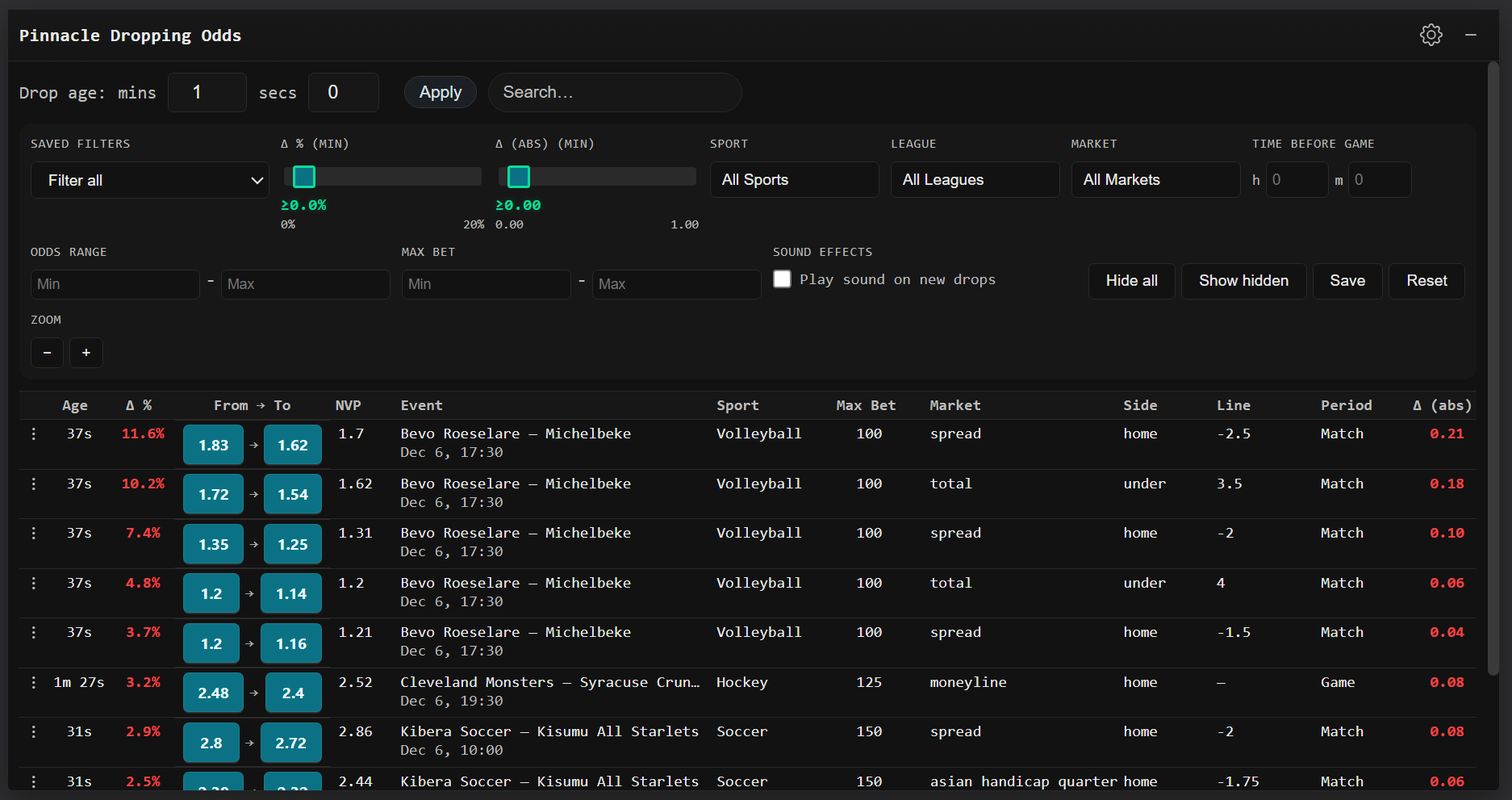
The max time to match start filter is a crucial setting that determines which events you'll receive alerts for based on how soon they're starting.
This filter helps you focus on matches that are starting within your preferred time window, balancing between market efficiency and capital turnover.
Understanding how this filter works and how to set it optimally can significantly impact your betting strategy and profitability.
For more information on configuring all your alert filters, see our tailoring alert configurations guide.
How Does the Max Time to Match Start Filter Work?
The max time to match start filter allows you to control how close the event has to be to starting in order to be alerted.
For example, if you set it to 24 hours and the odds drop on an outcome for an event that starts in 30 hours, you won't be alerted. However, if the event starts in 15 hours, you will be alerted as it starts within 24 hours.
You can set this filter using hours and minutes. The filter checks the event start time and only shows alerts for matches that begin within your specified time window.
If you leave both fields empty, you'll receive alerts for all upcoming matches regardless of when they start.
This filter is particularly useful for managing your betting workflow and ensuring you're focusing on matches that align with your strategy and availability.
For more information on understanding event timing, see our Pinnacle dropping odds manual.
Recommended Max Time to Match Start
We recommend setting your max time to match start filter to two days if you are new to dropping odds betting.
This gives you a good balance between having enough opportunities to bet on while still focusing on markets that are relatively efficient.
Other max times can work well depending on your goals and strategy, but taking into consideration market efficiency and turnover, we believe two days is the optimal setting for most users.
As you gain experience, you may want to adjust this filter based on:
- Your betting schedule and availability
- Your focus on turnover vs market efficiency
- The sports and markets you're betting on
- Your bookmaker coverage and how quickly they adjust
Some experienced bettors prefer shorter time windows (12-24 hours) to focus on more efficient markets and increase turnover, while others use longer windows (3-7 days) to capture more opportunities.
The key is finding the setting that works best for your specific situation and betting goals.
Effect on Market Efficiency
When a sharp bookmaker opens a new market, it is, relatively speaking, quite inefficient. This is because there is lots of uncertainty.
As the match approaches, information like confirmed lineups and the weather become available, so uncertainty decreases, which means the bookmaker can price the market more effectively.
On top of the 'fundamental' information, the bookmaker also gets pricing guidance from the flow of money, specifically sharp money throughout the life of the market.
So as sharp money flows into one side of the market, the bookmaker will drop the odds in response. These adjustments bring the market closer to perfect efficiency over time.
So what does this mean? It means if you want to receive alerts for more efficient markets, then set the max time to match start filter so that you only receive alerts for matches close to starting.
However, you can and should still bet on less efficient markets using the margin of safety principle, so there isn't necessarily a need to limit your alerts to within a short time before the match starts.
The margin of safety principle demands that you only take a bet on a market if the premium to the sharp bookmaker's No Vig Price (NVP) is proportional to the market efficiency, which can be estimated by analyzing the limit and vig together.
This is a whole topic in itself, so I do recommend reading more about market efficiency and the margin of safety principle as it will help you greatly when it comes to setting this filter.
For more information on market efficiency and NVP, see our No Vig Price (NVP) guide and Pinnacle dropping odds manual.
One important thing to be aware of: if you decide to start betting closer to the start of the match, some bookmakers will take the markets offline within 5-10 minutes of kickoff, so you may well find fewer opportunities if you focus on bets too close to kickoff.
Effect on Turnover
Let's imagine that we place two almost identical bets with an expected value of 5%. One of the bets is for a match that starts in three days, and the other is for a match that starts in two hours.
If we could only place one of the bets, then of course we would place the one on the game that starts in two hours because we are going to lock our capital up for a far shorter amount of time.
Once this bet has settled, we can place another bet at 5% EV, whereas with the first bet we have to wait three days for our bet to settle before we can re-deploy that capital.
We might be able to place nine or ten bets in the three days that it takes for the second bet to settle!
Higher turnover can mean better overall ROI (return on investment) even if the average yield of your bets is less.
So for this reason, many bettors tend to keep their max time to match start filter close to match start.
This strategy works particularly well if you:
- Have sufficient bankroll to maintain multiple positions
- Can monitor markets actively throughout the day
- Have quick access to multiple bookmakers
- Want to maximize capital efficiency
However, focusing too heavily on turnover can sometimes lead to placing bets on less valuable opportunities. Always prioritize positive expected value over turnover.
For more information on optimizing turnover while maintaining profitability, see our betting turnover optimization guide.
Ready to configure your max time to match start filter? Use FairOdds Terminal to set up custom alert filters and optimize your dropping odds strategy for maximum efficiency and turnover.
Max Time to Match Start Filter FAQ
How does the max time to match start filter work?
The max time to match start filter allows you to control how close the event has to be to starting in order to be alerted. For example, if you set it to 24 hours and the odds drop on an outcome for an event that starts in 30 hours, you won't be alerted. However, if the event starts in 15 hours, you will be alerted as it starts within 24 hours.
What is the recommended max time to match start?
We recommend setting your max time to match start filter to two days if you are new. Other max times can work well, but taking into consideration market efficiency and turnover, we believe this is the optimal setting for most users.
How does the max time to match start affect market efficiency?
When a sharp bookmaker opens a new market, it is relatively inefficient because there is lots of uncertainty. As the match approaches, information becomes available and uncertainty decreases, meaning the bookmaker can price the market more effectively. If you want to receive alerts for more efficient markets, set the max time to match start filter so that you only receive alerts for matches close to starting.
How does the max time to match start affect turnover?
Higher turnover can mean better overall ROI even if the average yield of your bets is less. Bets closer to match start lock up your capital for shorter periods, allowing you to place more bets with the same capital. For this reason, many bettors keep their max time to match start filter close to match start.