Limit Range Filter
The limit range filter (also called Max Bet filter) allows you to filter alerts based on the maximum bet size the sharp bookmaker will accept. Learn how limits indicate market efficiency and why constraining yourself to only high-limit markets can hurt your turnover.
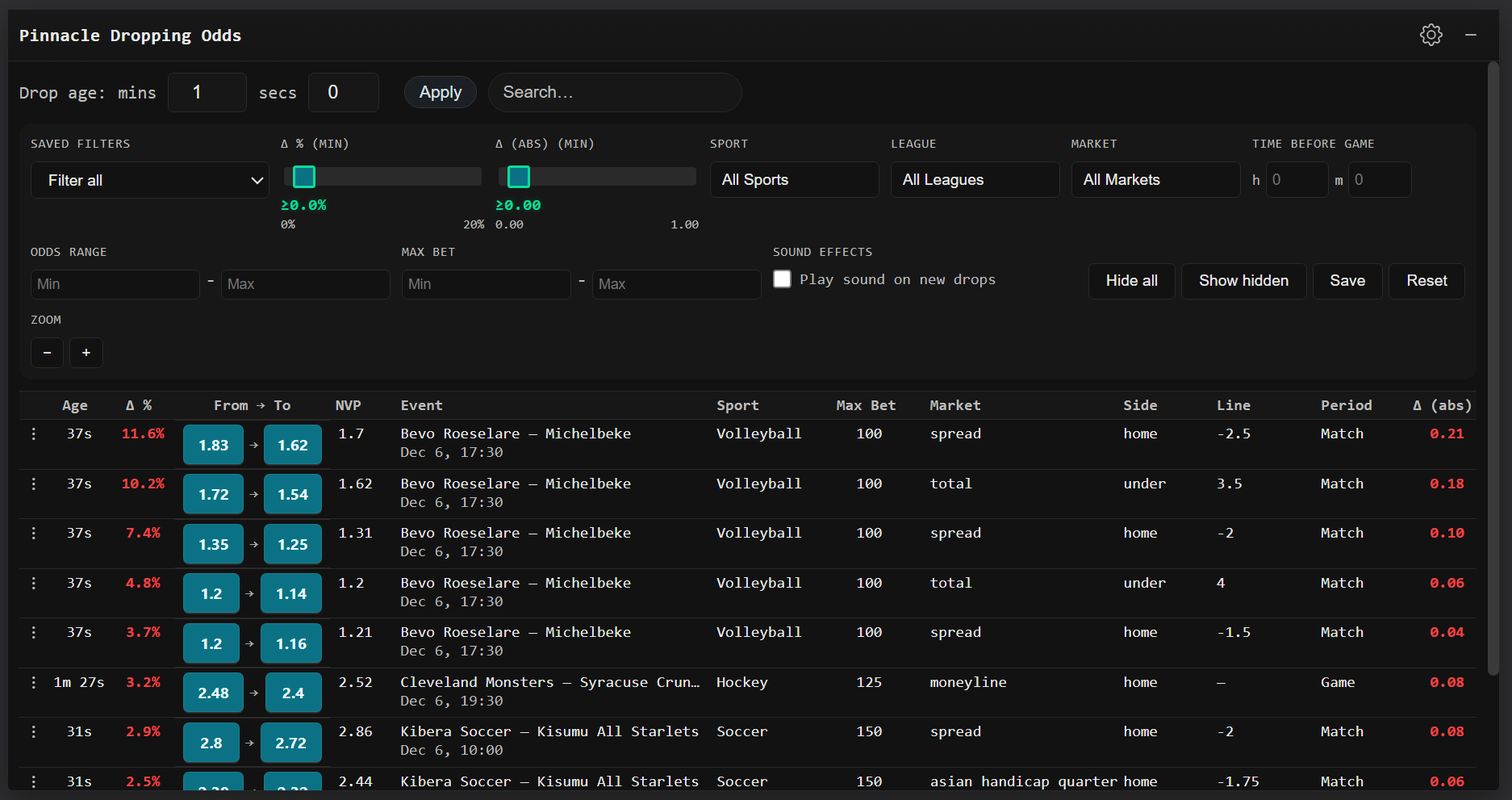
The limit range filter is an important tool for understanding market efficiency and managing your alert volume.
This filter helps you focus on markets where the sharp bookmaker has sufficient confidence in their pricing, while still allowing you to access valuable opportunities in less efficient markets.
Understanding how limits work and how to set this filter correctly can significantly impact both the quality of your alerts and your overall betting turnover.
For more information on configuring all your alert filters, see our tailoring alert configurations guide.
How Does the Limit Range Filter Work?
The limit range filter allows you to set a lower and upper bound for the sharp bookmaker's limit at the time of the alert.
The limit is the amount of money the bookmaker will accept in bets on a particular market at a particular price. It represents the maximum bet size you can place at that specific price point.
It is a proxy for the bookmaker's confidence in the efficiency of the line. Higher limits generally indicate that the bookmaker is more confident in their pricing, while lower limits suggest more uncertainty.
You can set both a minimum and maximum limit value. Only drops where the sharp bookmaker's limit falls within your specified range will trigger alerts.
For example, if you set your limit range to $100 - $10,000, you'll only receive alerts for markets where the sharp bookmaker is willing to accept bets between $100 and $10,000 at the current price.
This filter helps you balance between market efficiency (higher limits) and opportunity volume (including lower limits).
For more information on understanding limits and market efficiency, see our Pinnacle dropping odds manual.
Recommended Limit Range
We recommend setting your limit range to $100 - $1,000,000 if you are a beginner.
Taking into account turnover and market efficiency, this is in our opinion the best range as long as you are betting with a margin of safety.
This wide range allows you to:
- Access both efficient and less efficient markets
- Receive a good volume of alerts
- Maintain flexibility in your betting strategy
- Learn which limit ranges work best for your situation
As you gain experience, you may want to adjust this range based on:
- Your bankroll size and betting capacity
- Your focus on turnover vs market efficiency
- The sports and markets you're betting on
- Your ability to apply the margin of safety principle
Some bettors prefer narrower ranges (e.g., $500 - $50,000) to focus on moderately efficient markets, while others keep the range wide to maximize opportunities.
The key is finding the balance that works for your strategy while ensuring you're applying proper risk management.
Effect on Market Efficiency
The sharp bookmaker will progressively accept more and more money in bets as they get more and more confident that their price is right.
The amount of money the bookmaker will accept in bets from any one bettor at a particular price is called the 'limit'.
Therefore, we can get a good sense of the bookmaker's confidence in a price based on their limit.
When markets first open, limits are typically low because there's more uncertainty. As information becomes available and sharp money flows into the market, the bookmaker adjusts their odds and increases limits.
Higher limits generally indicate:
- More efficient pricing
- Greater confidence in the odds
- More liquidity in the market
- Less uncertainty about the outcome
Lower limits generally indicate:
- Less efficient pricing
- More uncertainty
- Less liquidity
- Markets far from match start or with limited information
So we come to the same question of whether we should be betting into low-limit markets.
I argued earlier that yes we should, as long as we apply the margin of safety principle with discipline, so I won't go over that argument again.
However, I will say this: if you constrain yourself to only high-limit markets, then your turnover will be massively inhibited for two reasons:
- You'll receive fewer alerts: High-limit markets are less common, especially early in the market lifecycle. By filtering out lower-limit markets, you're significantly reducing the number of opportunities available to you.
- Soft bookmakers adjust to high-limit market drops quicker: Soft bookmakers often have higher limits themselves on these markets, so they need to be more price sensitive. When a sharp bookmaker drops odds on a high-limit market, soft bookmakers are more likely to have already adjusted or will adjust very quickly, leaving less time for you to place your bet.
This doesn't mean you should ignore limits entirely. Instead, use the limit range filter to maintain a balance that allows you to access both efficient and less efficient markets while applying the margin of safety principle.
For more information on market efficiency and the margin of safety principle, see our Pinnacle dropping odds manual and No Vig Price (NVP) guide.
Ready to configure your limit range filter? Use FairOdds Terminal to set up custom alert filters and optimize your dropping odds strategy with the right balance of market efficiency and opportunity volume.
Limit Range Filter FAQ
How does the limit range filter work?
The limit range filter allows you to set a lower and upper bound for the sharp bookmaker's limit at the time of the alert. The limit is the amount of money the bookmaker will accept in bets on a particular market at a particular price. It is a proxy for the bookmaker's confidence in the efficiency of the line.
What is the recommended limit range?
We recommend setting your limit range to $100 - $1,000,000 if you are a beginner. Taking into account turnover and market efficiency, this is in our opinion the best range as long as you are betting with a margin of safety.
How does the limit indicate market efficiency?
The sharp bookmaker will progressively accept more and more money in bets as they get more and more confident that their price is right. Therefore, we can get a good sense of the bookmaker's confidence in a price based on their limit. Higher limits generally indicate more efficient markets, while lower limits indicate less efficient markets.
Should I only bet on high-limit markets?
No. If you constrain yourself to only high-limit markets, your turnover will be massively inhibited for two reasons: 1) you'll receive fewer alerts, and 2) soft bookmakers adjust to high-limit market drops quicker as they often have higher limits themselves, so they need to be more price sensitive. You can bet on low-limit markets as long as you apply the margin of safety principle with discipline.